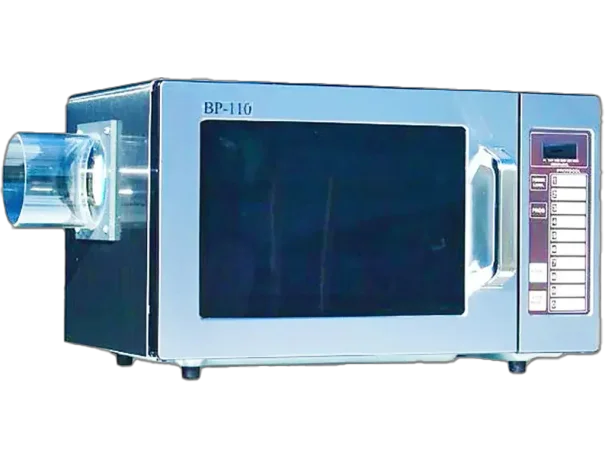
A laboratory microwave oven is a scientific heating system that uses microwave radiation combined with active feedback control to achieve precise, reproducible thermal processes under controlled conditions.
Key Design Differences
Unlike kitchen units, laboratory systems use reinforced cavities, chemical-resistant materials, calibrated sensors, and programmable controllers. They are engineered for data, not convenience.
Understanding Temperature and Power Control
Why Power Control Alone Is Not Enough
Power is not temperature. Delivering 800 watts does not guarantee 120°C. Different samples absorb energy differently. Solvents, solids, and mixtures respond in unpredictable ways if temperature is not measured directly.
The Role of Real-Time Temperature Feedback
Real-time temperature feedback closes the loop. The system adjusts microwave output dynamically to maintain the target temperature. This is the difference between guessing and knowing.
Temperature Measurement Technologies
Accurate temperature measurement is the backbone of controlled microwave heating.
Fiber Optic Sensors
Fiber optic probes are immune to electromagnetic interference. They can be placed directly in the sample, providing fast and accurate readings without disturbing the microwave field.
Infrared Sensors
Infrared sensors measure surface temperature without contact. They are ideal for open vessels and drying applications, though they do not see inside opaque materials.
Thermocouples
Special microwave-compatible thermocouples can be used in some systems. They are robust and familiar, though slightly slower than fiber optics.
PID Control in Laboratory Microwaves
What PID Control Means
PID stands for Proportional, Integral, and Derivative control. It is a control algorithm that continuously compares measured temperature to the target value.
How PID Improves Heating Accuracy
Instead of overshooting and correcting later, PID anticipates changes. It smooths heating curves, reduces thermal stress, and maintains stability even during exothermic reactions.
Heating Profiles and Process Programming
Ramp Rate Control
Ramp rate defines how fast the temperature rises. Slow ramps protect sensitive samples. Fast ramps accelerate digestion or synthesis.
Maximum Temperature Limits
Safety and reproducibility demand hard limits. Laboratory microwaves allow users to define absolute temperature ceilings that cannot be exceeded.
Hold and Soak Time
Holding a sample at a precise temperature for a defined period ensures reaction completeness, consistent drying, or uniform digestion.
Common Laboratory Applications
Chemical Sample Digestion
Laboratory Microwave digestion is one of the most widespread applications. Acids heated under controlled conditions break down complex matrices quickly and reproducibly.
Drying and Moisture Removal
Laboratory Microwaves remove moisture rapidly without overheating the entire sample chamber. This is especially useful for powders, filters, and granulates.
Synthesis and Reaction Acceleration
Microwave-assisted synthesis shortens reaction times and can improve yields. Controlled temperature prevents runaway reactions.
Biological and Pharmaceutical Uses
From media preparation to controlled heating of formulations, laboratory microwaves support workflows where precision matters more than speed alone.
Safety Features in Laboratory Microwave Ovens
Pressure and Vessel Monitoring
Closed vessels can build pressure rapidly. Laboratory systems monitor pressure continuously and stop the process if limits are exceeded.
Door Interlocks and Shielding
Multiple interlocks prevent operation if the door is not sealed. Shielding ensures zero microwave leakage into the laboratory environment.
Overtemperature Protection
Independent safety sensors act as a final barrier if control systems fail or unexpected reactions occur.
Materials and Vessels Used
Microwave-Compatible Containers
Special polymers, quartz, and ceramics are used to avoid absorption hotspots and chemical degradation.
Closed vs Open Vessel Systems
Closed vessels allow higher temperatures and faster reactions. Open systems provide flexibility and visual monitoring.
Advantages Over Conventional Heating
Speed and Efficiency
Microwave heating reduces processing times dramatically. What once took hours can take minutes.
Uniform Internal Heating
Because energy is absorbed throughout the sample, thermal gradients are reduced.
Energy Optimization
Energy goes into the sample, not the surrounding air or metal walls. This improves efficiency and repeatability.
Selecting the Right Laboratory Microwave
Power Range and Capacity
Higher power enables faster heating, but control resolution is equally important. Bigger is not always better.
Temperature Accuracy Requirements
Analytical labs demand tighter tolerances than routine preparation labs. Sensor choice matters.
Compliance and Standards
Look for systems designed to meet laboratory safety standards and documentation requirements.
Maintenance and Calibration
Sensor Calibration
Temperature sensors must be calibrated regularly to maintain accuracy and traceability.
Routine Safety Checks
Door seals, interlocks, and shielding should be inspected as part of standard laboratory maintenance.