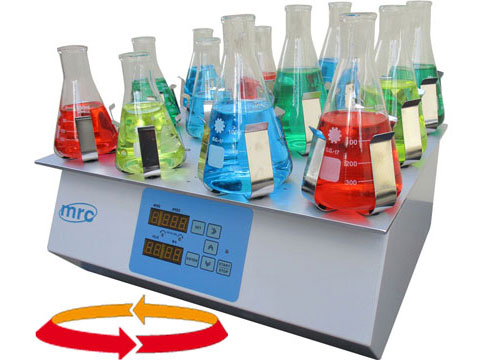
Monro TOS series orbital shakers are designed to agitate Erlenmeyer flasks and test tubes with a circular rotational motion for extended periods, including hours or days, even under heavy loads with multiple Erlenmeyer flasks, containers, and test tubes.
The shaker is equipped with an eccentric shaking system based on counterweights, built for intensive use over weeks and months under heavy loads.
Monro TOS shakers are popular in laboratories of beverage manufacturers, algae cultivation, biological labs, vitamin and food supplement producers, and life science laboratories for cell culture, plant, and seed research.
In beverage factories, Munro orbital shakers are used to test yeast and mold content in drinks by inoculating them in liquid media inside Erlenmeyer flasks. The flasks are then shaken for enrichment, followed by visual inspection.
Using Munro Orbital Shakers for Algae Cultivation in Laboratory Conditions
- Aeration: Algae require oxygen to grow, and shaking the culture ensures sufficient aeration, providing the algae with access to the oxygen needed for metabolism.
- Distribution of Nutrients: Shaking helps evenly distribute nutrients throughout the algae culture, ensuring that all algae receive adequate nutrition for growth.
- Preventing Clumping: Algae cultures tend to clump together, which can hinder growth. Shaking prevents aggregation and keeps the algae well-dispersed in the culture medium.
- Preventing Sedimentation: Shaking keeps the algae from settling at the bottom of the culture vessel, where conditions are less favorable for growth.
- Increased Growth Rate: By creating optimal growth conditions, including aeration and nutrient distribution, shaking can enhance the growth rate of algae cultures, leading to higher biomass production.
Below is a guide to choosing the right Orbital Shakers.
Selecting the best shaker while purchasing a new one might be challenging. To help with this choice, before searching for the perfect shaker, there are a few factors you need to know:
1. Temperature range:
To fit different growth requirements, orbital shakers may be set to a wide range of temperatures. They vary from low-temperature models that can reach as high as 80 ° C for thermophile cultivation and as low as 4 ° C for protein expression.
2. Vessels required to shake:
Assortments of clamps are available for Erlenmeyer flasks, separatory funnels, microwell plates, beakers, and test tubes.. Adhesive mats and tapes are available to accommodate different vessel sizes for slow-speed applications under 250 rpm.
3. Shaking speed:
It is possible for models to be capable of staining at a low speed of 15 rpm in slow-speed staining applications and staining at high speed of 500 rpm in high-speed staining applications. Depending on the type of interface used (analog or digital), the speed range may have limitations if the interface is stacked or will vary.
4. Space:
Orbital shakers are available in a variety of sizes, with the smallest bench top unit being 18"L x 14"W x 7"H and the biggest stackable floor unit measuring 34"L x 47"W x 25"H. There are several intermediate sizes. In addition to microwell plates, Erlenmeyer flasks, and beakers, there are also separatory funnels, centrifuge tubes, separatory funnels, and beakers available.
5. Platform:
Typically, manufacturers offer a dedicated platform that can only shake one size of the vessel, like a flask. Unlike universal platforms, which allow a mix of different sized labware to be used on a single platform, these platforms provide maximum capacity and include installed clamps. You can add and interchange clamps and test tube racks as you see fit using the numerous mounting holes on the universal platform.
A shaker manufacturer might also offer a shaker that can accommodate multiple platforms of different sizes or platform stacks to double capacity, not just the footprint.
6. Speed and temperature accuracy:
The accuracy of digital shakers is better if speed and temperature accuracy are important. In contrast to analogue controls, the data is displayed on an LED screen. This feature may be important in situations requiring repeatability.
7. The weight placed on the shaker:
For maximum performance, shakers have weight limits. A triple eccentric drive shaker may be the best option. Compared to shakers using single eccentric drives, eccentric triple drives can handle heavy workloads.
8. The number of people using the shaker:
Purchasing additional platforms for quick vessel changes may be beneficial if several individuals use a shaker in the lab. By having their clamps attached to different platforms, if one researcher grows bacteria in a centrifuge tube and another grows yeast cultures in Erlenmeyer flasks, it will save them a great deal of time.
There are various shaker options available in the market according to your application needs. Choosing the appropriate unit as per needs is crucial for work efficiency. The abovementioned factors will surely guide you in choosing an appropriate orbital shaker.