Heating is one of the most common operations in scientific laboratories. From chemical synthesis to biological sample preparation, controlled heating is essential for many experimental procedures. Traditionally, laboratories relied on simple laboratory hotplates that provide stable heat to flasks, beakers, and other containers.
However, many modern laboratories prefer using laboratory hotplates with magnetic stirrers, a device that combines heating and continuous liquid mixing in a single instrument.
Although both instruments serve the purpose of heating samples, the functionality, efficiency, and experimental accuracy differ significantly. Understanding these differences is important for laboratory technicians, researchers, and quality control laboratories when selecting the right equipment.
This article explains the key differences between a regular laboratory hotplate and a laboratory hotplate with magnetic stirrer, including how they work, their advantages, and when each type should be used.
What Is a Laboratory Hotplate?
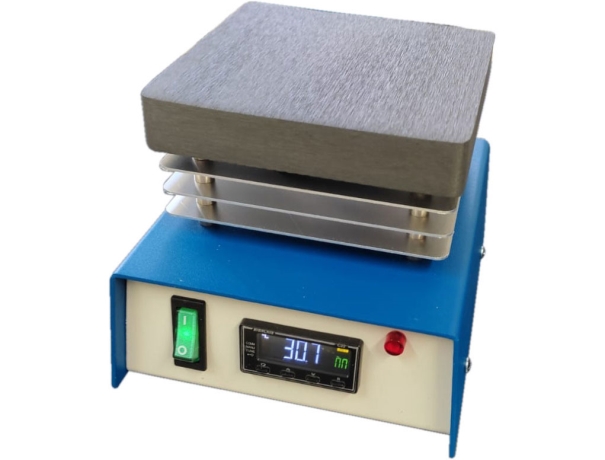
A laboratory hotplate is a heating device designed to heat liquids or solid samples placed in laboratory containers such as beakers, flasks, or test tubes.
Typical components include:
-
Heating surface (ceramic, aluminum, or stainless steel)
-
Temperature control system
-
Heating element
-
Power control interface
The main function of a hotplate is simple: to supply controlled heat to a sample container placed on the surface.
Hotplates are widely used in:
-
Chemistry laboratories
-
Pharmaceutical research
-
Food testing laboratories
-
Environmental laboratories
-
Academic research facilities
Because of their simplicity and durability, regular hotplates are still common in many laboratories.
What Is a Laboratory Hotplate with Magnetic Stirrer?
A laboratory hotplate with magnetic stirrer combines two functions in one device:
-
Heating
-
Continuous mixing
Inside the device is a rotating magnetic field that spins a small magnetic bar placed inside the liquid sample. This magnetic bar, commonly called a stir bar, rotates rapidly and mixes the liquid.
This creates uniform mixing while the sample is heated, which significantly improves heat distribution and chemical reaction efficiency.
Hotplate stirrers are widely used in laboratories working with:
How a Regular Laboratory Hotplate Works
A standard laboratory hotplate works using a resistive heating element beneath the heating surface.
Heating process
-
Electrical current passes through the heating element.
-
The heating element produces heat.
-
Heat is transferred to the hotplate surface.
-
The container placed on the surface receives heat through conduction.
This process heats the liquid or solid sample inside the container.
However, no mixing occurs unless the user manually stirs the liquid.
This can create uneven temperature distribution within the sample.
How a Magnetic Stirrer Hotplate Works
A magnetic stirrer hotplate operates using two integrated systems:
Heating system
The heating element functions similarly to a regular hotplate.
Magnetic stirring system
Below the heating plate is a rotating magnet driven by a motor.
Inside the liquid sample is a magnetic stir bar. When the magnetic field rotates, the stir bar spins, creating a vortex that continuously mixes the liquid.
This provides:
-
Uniform temperature distribution
-
Faster dissolution of chemicals
-
Improved reaction control
Key Differences Between a Regular Hotplate and a Hotplate with Magnetic Stirrer
1. Mixing Capability
Regular hotplate
Hotplate with magnetic stirrer
This is one of the most important advantages of hotplate stirrers.
2. Temperature Uniformity
When liquids are heated without mixing, the bottom layer becomes hotter than the upper layers.
This creates temperature gradients.
With a magnetic stirrer:
This improves experimental accuracy.
3. Reaction Efficiency
Many laboratory reactions depend on uniform reagent distribution.
Without stirring:
Magnetic stirring ensures:
-
Constant reagent contact
-
Faster reaction rates
-
Better reproducibility
4. Dissolving Solids in Liquids
In many laboratory procedures, powders must dissolve into liquids.
Examples include:
Using only a hotplate may result in slow or incomplete dissolution.
A magnetic stirrer provides:
5. Experimental Reproducibility
Modern laboratories emphasize repeatability and standardization.
Hotplate stirrers allow:
-
Precise temperature control
-
Adjustable stirring speed
-
Consistent experimental conditions
This is especially important in:
6. Safety Improvements
Hotplate stirrers often include additional safety features such as:
Continuous stirring also prevents localized overheating, which can degrade temperature-sensitive materials.
Advantages of Laboratory Hotplates with Magnetic Stirrers
Improved Heat Distribution
Continuous mixing eliminates hot spots and ensures uniform heating.
Faster Chemical Reactions
Efficient mixing increases contact between reactants.
Greater Experimental Accuracy
Stable temperature and homogeneous mixing improve result reliability.
Reduced Manual Work
Researchers do not need to manually stir samples.
Multi-Function Instrument
One device performs both heating and mixing.
When a Regular Laboratory Hotplate Is Still Useful
Despite the advantages of hotplate stirrers, regular hotplates still have practical applications.
Situations where simple hotplates are suitable include:
Regular hotplates are also typically more affordable and mechanically simpler.
Typical Applications of Hotplate Stirrers
Hotplate stirrers are widely used in modern laboratories.
Common applications include:
Chemical Laboratories
-
Reaction heating
-
Catalyst preparation
-
Solution synthesis
Biological Laboratories
-
Media preparation
-
Enzyme reactions
-
Sample mixing
Pharmaceutical Laboratories
-
Drug formulation
-
Dissolution studies
-
Buffer preparation
Environmental Testing
-
Water sample preparation
-
Chemical digestion
-
Sample homogenization
Choosing the Right Laboratory Hotplate
When selecting between a regular hotplate and a hotplate with magnetic stirrer, laboratories should consider:
Sample type
Volume of liquid
Large volumes may require stronger stirring motors.
Temperature requirements
Some models reach temperatures above 500°C.
Control systems
Modern units may include:
Text Anchors Related to Laboratory Heating Equipment
Researchers interested in laboratory heating technology often search for related equipment and applications such as:
-
laboratory heating equipment
-
magnetic stirrer hotplate
-
digital laboratory hotplate
-
laboratory mixing equipment
-
scientific heating plates
-
chemical reaction heating systems
-
laboratory temperature control equipment
These related technologies support a wide range of laboratory workflows.