Sandblasting is the process of propelling fine abrasive particles at high velocity to clean, shape, or prepare a surface. Think of it like pressure washing, but with sand or similar media instead of water—and way more precision.
How Does a Sandblasting Cabinet Work?
A sandblasting cabinet is a sealed enclosure that allows operators to sandblast materials without releasing dust and debris into the environment. It typically includes a nozzle, air compressor, glove ports, and a viewing window for maximum control and safety.
Key Components of a Fine Sandblasting Unit
Nozzles and Tips
Nozzles determine the shape and intensity of the blasting stream. Fine-tipped nozzles are essential for delicate work like dentistry or jewelry restoration.
Air Compressor System
This powers the abrasive stream. For lab applications, you’ll want a compressor that allows precise pressure adjustments for different tasks.
Abrasive Media Types
From aluminum oxide and glass beads to walnut shells, the media choice depends on the application. Finer abrasives offer more control for delicate work.
Lighting and Visibility Features
Built-in LED lights and clear-view windows are essential for accuracy. You can’t blast what you can’t see clearly.
Filtration and Dust Collection
High-quality filtration systems keep dust and debris from escaping into the lab environment. A HEPA filter is often preferred.
Types of Laboratory Sandblasting Cabinets
Manual Sandblasting Cabinets
These are controlled entirely by the operator. Ideal for small-scale or custom jobs that require human finesse.
Automated Sandblasting Systems
For higher volume or repetitive tasks, automated systems reduce human error and increase efficiency.
Benchtop vs Floor-Standing Models
Benchtop units save space and are great for small labs. Floor-standing models, however, offer more power and capacity for larger workloads.
Applications in the Laboratory Environment
Dental Laboratories
From crown surface preparation to removing investment materials, dental labs rely heavily on sandblasting units.
Jewelry and Watchmaking
Need to restore a vintage Rolex or add texture to a gold pendant? A fine sandblasting unit gets the job done cleanly.
Electronics and Precision Parts Cleaning
Remove oxides, flux, or contaminants without damaging sensitive parts. That’s why circuit board manufacturers love these cabinets.
Prototyping and Microfabrication
In R&D environments, prototypes need precise surface treatments, and these units offer exactly that.
Advantages of Using a Fine Sandblasting Cabinet
Precision Cleaning
Get into tiny crevices and polish surfaces with unmatched accuracy.
Material Conservation
Unlike mechanical grinding, sandblasting removes minimal material, preserving the integrity of the workpiece.
Safety and Containment
No flying dust or debris. All action happens inside the sealed cabinet.
Time Efficiency
Tasks that used to take hours manually can now be done in minutes.
Choosing the Right Unit for Your Lab
Size and Capacity
Make sure the cabinet fits your largest workpiece and doesn't hog too much lab space.
Type of Abrasive Media
Choose based on the material you’re working on. Glass beads for cleaning, aluminum oxide for roughening.
Pressure Control Features
Look for units that allow easy pressure adjustments for different tasks.
Budget and Brand Reliability
You don’t want to skimp here. Invest in a reputable brand to avoid downtime and costly repairs.
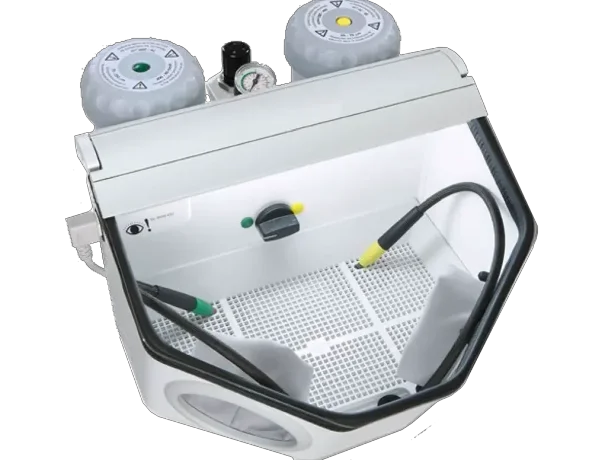
SANDB-BE Fine Sandblasting Unit
The SANDB-BE is a compact fine sandblasting unit supplied by Munro Scientific, designed specifically for precise, clean, and cost-efficient sandblasting in laboratory, prototyping, dental, or small workshop environments. According to the official specification sheet, it integrates advanced mixing chamber technology, LED lighting, and flexibility in configuration (with one or two blasting tanks).
1. Key Features & Advantages
From the specification sheet, the SANDB-BE unit offers several compelling features:
Cost Efficiency via Mixing Chamber (Venturi Principle)
- The unit employs a special mixing chamber technology based on the Venturi principle,, which helps reduce abrasive consumption and improve efficiency.
- The Venturi effect allows for efficient entrainment of abrasive particles with minimal compressed air loss, which is particularly beneficial when working with fine abrasive media.
Precise Blasting & Excellent Illumination
- The blasting chamber is well illuminated with LED lighting, giving users clear visibility of the blasting process.
- With good lighting and controlled nozzle behavior, operators can achieve very precise, focused blasting (sometimes called “pin-point accuracy”).
Flexible Configuration & Chambers
- The standard model has one blasting tank, but it can be extended to two tanks without tools, giving flexibility in switching between abrasive media sizes or dual-use workflows.
- The blasting chamber volume is 10 liters, which provides enough space for typical small workpieces while still being compact.
- Tank capacity is 1000 ml (≈ 34 fl oz) per tank.
Compact & Ergonomic Build
- The external dimensions are relatively modest: 350 × 275 × 400 mm (W × H × D) or about 13.8 × 10.8 × 15.7 inches.
- The empty weight (with two tanks) is about 5.5 kg (≈ 12.1 lbs), while the single-tank version weighs about 4.4 kg (≈ 9.7 lbs).
- This compact size and lower weight make it suitable for bench-top setups or semi-portable usage.
Broad Operating Range & Compatibility
- It supports different mains voltages: 220-240 V, 120 V, and 100 V.
- Frequency ranges (50/60 Hz) are accommodated.
- Working pressure range: 1–6 bar (≈ 14.5–87 psi)
- Maximum connection pressure: 6–8 bar (≈ 87–116 psi)
- At 6 bar, the air consumption is ~98 L/min (~3.46 cfm).
2. Technical Specifications (Highlights)
Here’s a distilled table of the main specs:
| Parameter | Value |
| Mains Voltage | 220–240 V, 120 V, 100 V |
| Frequency | 50 / 60 Hz |
| Working Pressure | 1 – 6 bar (14.5 – 87 psi) |
| Max Connection Pressure | 6 – 8 bar (87 – 116 psi) |
| Air Consumption (at 6 bar) | 98 L/min (~3.46 cfm) |
| Illumination Intensity | 4800 lx |
| Lamp Power | 9 W |
| Dimensions (W × H × D) | 350 × 275 × 400 mm |
| Blasting Chamber Volume | 10 L |
| Tank Capacity | 1000 mL (each) |
| Number of Tanks | 1 – 2 (tool-free addition) |
| Weight (empty, 2 tanks) | ~5.5 kg |
| Weight (empty, single tank) | ~4.4 kg |
In addition, the specification sheet lists product variants by abrasive grain size and voltage, e.g.:
- SANDB-BE, 25–70 µm, 230 V
- SANDB-BE, 70–250 µm, 230 V
- Mixed or dual-range 25–70 µm / 70–250 µm
- Similar variants for 120 V and 100 V supply configurations
This means the unit can be ordered to match local power standards and the desired abrasive size (fine or coarser) or even mixed capability.
3. Use Cases & User Benefits
Given its feature set, the SANDB-BE is well-suited for several applications:
Applications
- Laboratory or research settings — for preparing small samples, cleaning, etching, or surface treatment of test specimens.
- Dental labs / prosthetics / jewelry — where fine, controlled abrasive blasting is needed to clean, texture, or mat surfaces without damaging delicate structures.
- Prototyping / small parts workshops — finishing or surface prep of small metal, ceramic, or glass parts.
- Restoration / conservation of small artifacts — where precise removal of coatings, corrosion, or contaminants is needed without harming the substrate.
Benefits to the User
- Abrasive efficiency: The Venturi-based mixing chamber reduces waste and optimizes abrasive usage, cutting operational cost.
- Precision: LED-illuminated chamber and controlled air/abrasive flow help the operator see exactly what’s happening, enabling very fine, localized blasting.
- Flexibility: Having one or two tanks easily swappable allows the user to alternate abrasives (e.g. one for fine grit, another for coarser grit) without major downtime.
- Compact footprint: Takes up minimal bench space and is relatively lightweight, making it more practical in small labs or workshops.
- Voltage versatility: Because you can order versions for different voltages, it’s usable in many countries.