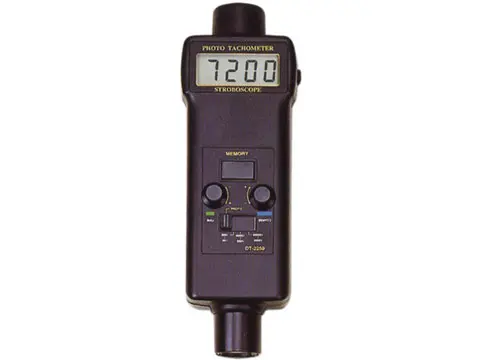
A tachometer is an essential device used to measure the rotational speed of an object, usually in revolutions per minute (RPM). Whether in cars, airplanes, or industrial machinery, tachometers help ensure efficiency and safety by monitoring speed.
Kinds of Tachometers
Mechanical Tachometers
These traditional devices use centrifugal force to measure speed. They are commonly found in older vehicles and industrial machinery.
Digital Tachometers
Equipped with LED or LCD displays, digital tachometers offer precise readings and can store historical data, making them ideal for scientific and industrial applications.
Contact vs. Non-Contact Tachometers
Contact tachometers require direct contact with the rotating object, while non-contact versions use laser or optical sensors to measure speed from a distance.
Optical Tachometers
These tachometers use light reflection to measure RPM, making them perfect for high-speed applications.
Laser Tachometers
Laser tachometers offer accurate and non-invasive speed measurement, often used in delicate applications such as aerospace and medical equipment.
How Tachometers Work
A tachometer calculates RPM by detecting frequency or changes in motion. Depending on the type, it may use a magnetic sensor, optical sensor, or direct mechanical connection.
Applications of Tachometers
Tachometers are crucial in several industries:
- Automotive Industry – Tachometers are used in vehicles to measure the engine's RPM (revolutions per minute) to ensure optimal performance and prevent engine damage due to over-speeding.
- Industrial Machinery – In manufacturing plants, tachometers monitor the speed of motors, conveyors, and rotating equipment to maintain efficiency and prevent mechanical failures.
- Aerospace and Aviation – Used in aircraft to measure the RPM of engines and propellers, ensuring safe and efficient operation.
- Medical Equipment – In medical devices such as centrifuges and heart-lung machines, tachometers monitor rotational speeds for precision and safety.
- HVAC Systems – They help in monitoring the speed of fans, blowers, and compressors in heating, ventilation, and air conditioning systems.
- Wind Turbines – They measure the rotation speed of wind turbine blades to optimize power generation and prevent mechanical stress.
- Railway and Transportation – Used in trains and locomotives to monitor wheel speed and ensure safe travel.
- Power Plants – These are used in turbines and generators to monitor and control rotational speeds for efficient power production.
- Research and Development – They are widely used in laboratories for testing the performance of rotating components in engineering and scientific research.
- Sports and Exercise Equipment – Used in treadmills and cycling equipment to measure speed and performance.
How to Use a Tachometer Correctly
- Position the tachometer correctly.
- If using a contact tachometer, ensure firm contact.
- Read the displayed RPM carefully.
- Record measurements for future reference.