In a laboratory, stirring is a crucial procedure. It is employed for the breakdown of solid particles in liquids as well as the homogenization of liquids. It's also an effective approach to maintaining the liquid's proper temperature and concentration. The chemical reaction and the dissolving process are sped up when liquids are stirred.
When it comes to substances that are highly viscous or voluminous, an overhead stirrer handles the work of homogenizing, mixing, suspending, and recirculating them. Overhead stirrers allow you to keep an eye on a reaction's development as viscosity alters. When a magnetic stirrer cannot be employed, overhead stirrers are commonly used. Different stirrers are available for use in laboratories. Each of them has unique qualities that make them more effective for particular uses.
What you need to consider when buying an overhead stirrer:
- Speed of Stirring:
Depending on your requirement, the speed of the stirrer could vary. Various models come with different speeds, so you can choose accordingly.
- Quantity of sample:
Volumes of the samples might be as little as 2L or as much as 200L. This is why you should buy according to your needs.
- Accessories:
Zero torque, programmed mixing, a light, timer, Automatic shutdown, speed display, a stand, and digital torque display are additional accessories that you can opt for according to your laboratory needs.
- Viscousness:
Viscosity is how thick a fluid is when it is stirred. When mixing, additional torque is needed from the stirrer's motor due to higher viscosity. The stirrer needs to be able to keep going despite the changing viscosity conditions. That is why you should make sure the overhead stirrer can manage your batches' highest viscosities.
- Torque:
The rotational force required to turn a rotor and raise fluid pressure and flow is known as torque. The efficiency with which the stirrer can continue to rotate in very viscous mixtures increases with increasing torque. Due to any increase in speed and diameter, torque is affected, and more power is needed.
Overhead Stirrer Components:
An overhead stirrer is made up of three parts which include stands, rods and paddles. The following are some examples of the many paddle types:
- Turbine
For medium to high speeds a little shearing force, and an axial flow, a turbine is utilized.
- Dissolver
For medium to high speeds, large shear pressures, intense turbulence, particle reduction, and radial flow, a dissolver is employed.
- Centrifugal
For medium to high speeds, round containers with narrow necks, and an axial flow, a centrifugal is utilized.
- Anchor
For slower speeds, very viscous fluids, and tangential flows, an anchor is utilized.
- Propeller
In between medium to high speeds, light shearing forces, and axial flow, a propeller is utilized.
- Paddle
For speeds that are low to medium, with little turbulence and tangential flows, a paddle is utilized.
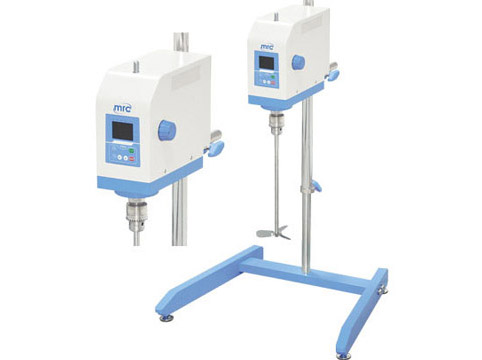
Munro Digital overhead stirrers deliver precision and reliability, making them essential for any laboratory setting.
They combine strength, reliability, and advanced functionality to meet the highest laboratory standards.
Whether working with low or high viscosities, or handling volumes up to 200 liters, our stirrers perform seamlessly across various applications, providing efficient solutions for every mixing task.
MUNRO overhead stirrers feature space-saving designs without compromising performance. Engineered to focus on essential functions, these high-performing stirrers are dependable and easy to operate, making them ideal for all laboratory environments.
Munro offer six versions, with speeds up to 3000 rpm and torque up to 70 Ncm, available in both digital and analog control models.
Also overhead stirrers with 3 Ncm digital version, perfect for precise stirring tasks.
Key Features:
- Safety Circuit: Ensures safe operation at all times.
- Clear, Intuitive Display: Real-time monitoring and control for precise adjustments.
- Versatile Stirring Tools: Wide selection of propellers.
- Compact Design: Streamlined to maximize efficiency while conserving space.
- Constant Torque: Ensures stable performance across the entire rpm range.
-Operating these stirrers is simple and intuitive.
- Digital Display: Shows rpm clearly, with control models also displaying torque.
- Integrated Timer .
- Fast Response Display.
- Versatile Impeller Designs: Supports a wide range of sample volumes and applications.