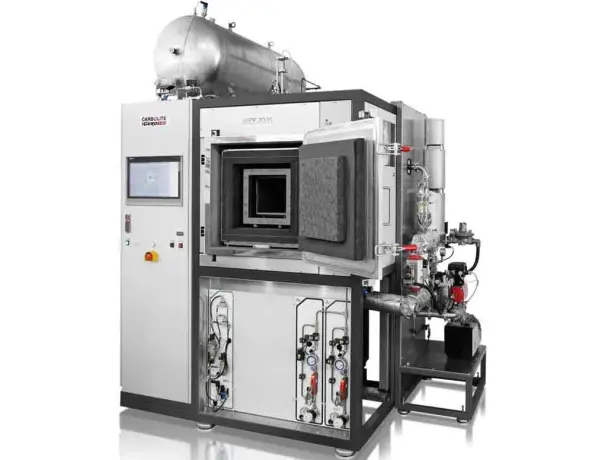
A vacuum furnace is a type of industrial furnace that operates in a vacuum-sealed environment. It uses high temperatures to process metals, alloys, and ceramics while minimizing oxidation, contamination, and unwanted chemical reactions.
How Do Vacuum Furnaces Work?
A vacuum furnace removes atmospheric gases from the heating chamber, creating a controlled environment for metal treatment. This prevents oxidation and ensures a clean, high-quality finish.
Components of a Vacuum Furnace
Vacuum Chamber
The core of the furnace, maintaining the controlled vacuum environment.
Heating Elements
Typically made from graphite, molybdenum, or tungsten, these elements provide uniform heating.
Insulation System
Ensures minimal heat loss and maintains energy efficiency.
Cooling System
Essential for rapid quenching and precise temperature control.
Gas System
Allows for controlled atmospheres using inert gases like argon or nitrogen.
Benefits
- Eliminates oxidation and contamination
- Provides precise temperature control
- Reduces waste and improves efficiency
- Produces high-quality finishes with minimal distortion
- Increases longevity of treated materials
Functions of Vacuum Furnaces
Aerospace Industry
Used for high-performance metal parts, turbine blades, and structural components.
Automotive Industry
Critical for heat-treating gears, bearings, and engine components.
Medical Device Manufacturing
Essential for sterilization and strengthening of medical implants and tools.
Tool and Die Industry
Used for hardening and tempering cutting tools, molds, and dies.
Common Heat Treatment Processes in Vacuum Furnaces
Annealing
Reduces hardness and improves ductility in metals.
Brazing
Used to join metal components with a filler material, ensuring high-strength bonds.
Carburizing
Enhances surface hardness by introducing carbon into the metal.
Hardening
Improves wear resistance by heating and quenching metals.
Materials Suitable for Vacuum Furnace Processing
- Stainless steel
- Titanium alloys
- Nickel-based superalloys
- Copper and brass
- Ceramics and composites
Vacuum Furnace Temperature Ranges
Vacuum furnaces operate between 500°C to 3000°C, depending on the material and process requirements.
Factors to Consider When Choosing a Vacuum Furnace
- Desired temperature range
- Workpiece size and material type
- Production volume
- Budget and operational costs
- Energy efficiency and environmental impact
What are the temperature ranges according to applications for VACUUM FURNACES
Vacuum furnaces are used across various industries for precise heat treatment, sintering, and brazing processes. The temperature ranges for vacuum furnaces depend on the specific application and the materials being processed. Here’s a breakdown of temperature ranges based on different applications:
1. Heat Treatment Applications
- Annealing (e.g., stainless steel, titanium, superalloys)
Temperature Range: 600°C – 1,200°C
Purpose: Reduces internal stresses, refines grain structure, and enhances ductility. - Hardening (e.g., tool steel, high-speed steel, aerospace alloys)
Temperature Range: 800°C – 1,300°C
Purpose: Increases hardness by forming martensite after quenching. - Tempering (after hardening)
Temperature Range: 150°C – 700°C
Purpose: Reduces brittleness while maintaining hardness. - Stress Relieving (e.g., castings, welded components, precision parts)
Temperature Range: 450°C – 900°C
Purpose: Minimizes residual stresses in metals.
2. Sintering Applications
- Powder Metallurgy Sintering (e.g., tungsten, molybdenum, stainless steel)
Temperature Range: 1,100°C – 2,200°C
Purpose: Consolidates metal powders into solid materials. - Ceramic Sintering (e.g., silicon carbide, alumina, zirconia)
Temperature Range: 1,200°C – 2,000°C
Purpose: Enhances mechanical properties of ceramic materials.
3. Brazing Applications
- Vacuum Brazing (e.g., aerospace, automotive, medical components)
Temperature Range: 850°C – 1,200°C (depending on filler material)
Purpose: Joins metal components with a filler material in a clean environment.
4. Coating and Deposition Applications
- Chemical Vapor Deposition (CVD) (e.g., tungsten carbide, diamond coatings)
Temperature Range: 800°C – 1,500°C
Purpose: Deposits thin films on tools, aerospace, and electronics components. - Physical Vapor Deposition (PVD) (e.g., titanium nitride coatings)
Temperature Range: 200°C – 800°C
Purpose: Improves surface hardness and wear resistance.
5. Advanced High-Temperature Applications
- Graphitization (e.g., carbon fiber, graphite materials)
Temperature Range: 2,000°C – 3,000°C
Purpose: Converts amorphous carbon to crystalline graphite. - Melting and Refractory Metal Processing (e.g., tantalum, niobium, tungsten)
Temperature Range: 2,500°C – 3,500°C
Purpose: Produces high-purity metals for aerospace and nuclear applications.