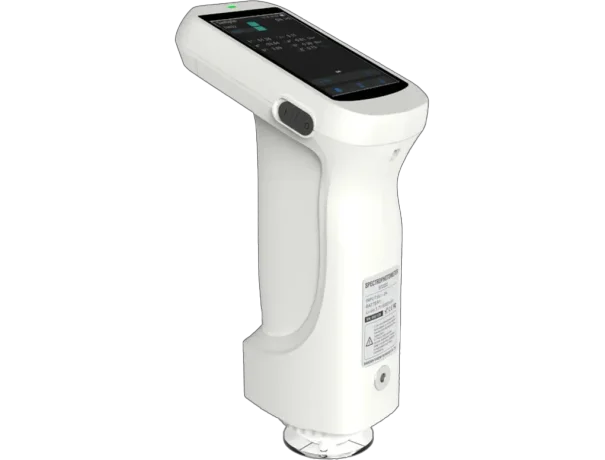
A spectrocolorimeter exists because human vision is brilliant at interpretation, but terrible at repeatable measurement. Your eyes adapt. The room lighting shifts. The background changes. Even your mood and fatigue can change perception. If you have ever argued with someone about whether a product is “slightly warmer” or “a bit greener,” you already know the problem.
Why your eyes are not a measuring instrument
Your visual system constantly compensates. Walk from sunlight into an office and your brain “white-balances” the scene in seconds. That is amazing for survival. It is a nightmare for quality control.
A spectrocolorimeter does not adapt. It measures.
The business cost of “close enough”
Small color differences create real costs: rework, scrap, rejected batches, delayed shipments, and brand damage. If your customer is matching parts (automotive interiors, consumer electronics housings, cosmetic packaging), tiny mismatches become big complaints.
That is why color measurement moved from “visual inspection” to “instrument-based standards.”
So, What Is a Spectrocolorimeter?
A spectrocolorimeter is an instrument that measures how a sample reflects (or sometimes transmits) light across many wavelengths, then converts that spectral data into color values like L*, a*, b* and Delta E under defined lighting and observer conditions.
Think of it like this: instead of guessing color, it reads the sample’s “light fingerprint.”
Spectrocolorimeter vs spectrophotometer vs colorimeter (quick clarity)
- Colorimeter: Measures color using broad filters that mimic the human eye’s sensitivity. Fast and simple, but less detailed. It often cannot reveal why two samples match in one light and fail in another.
- Spectrophotometer: Measures the spectrum in detail. In many industries, “spectrophotometer” is used broadly for instruments that produce spectral reflectance.
- Spectrocolorimeter: Commonly used to emphasize that the device measures spectrum and directly reports colorimetric values for color control workflows.
In practice, many modern instruments marketed as spectrocolorimeters are spectrophotometers optimized for color measurement and tolerancing.
How a Spectrocolorimeter Works
Here is the basic idea: shine controlled light on a sample, capture what comes back, split it into wavelengths, then compute numbers that represent color under standardized viewing conditions.
Light source, optics, and the measurement geometry
Inside the instrument is a stable light source and an optical setup that defines how light hits the sample and how reflected light is collected. This setup is called geometry, and it matters a lot. More on that later.
Diffraction grating (or prism): splitting light like a rainbow
A key part is the element that separates light into wavelengths.
If you have ever seen sunlight split by a prism into a rainbow, you have seen the concept. In a spectrocolorimeter, a diffraction grating (or sometimes a prism) spreads the reflected light into its spectral components so the detector can measure intensity at each wavelength band.
Detector and spectral reflectance curve
A detector captures the separated light and produces a spectral reflectance curve, typically across the visible range (often around 400 to 700 nm, sometimes wider).
That curve is the foundation. Everything else, like Lab* and Delta E, is computed from it.
The Spectral Reflectance Curve
What it is, in plain language
Imagine you ask the sample a question: “How much blue do you reflect? How much green? How much red?” The spectral reflectance curve is the sample’s answer across the entire visible spectrum.
Two samples can look similar, yet have different curves. That difference is where real-world problems show up.
Why it reveals “hidden” problems (metamerism, pigments, coatings)
This is the big advantage over simpler instruments. Spectral data can explain:
- Why two samples match under one light and fail under another
- Whether a pigment substitution happened
- Whether a coating thickness shift changed the optical behavior
- Whether fluorescence or optical brighteners are involved
A spectrocolorimeter is not just saying “these differ by Delta E 0.9.” It can help you understand why.
5. From Spectrum to Numbers: The Color Spaces
Spectral data is powerful, but production lines need pass/fail decisions. So the spectrum gets converted into standardized color values.
Tristimulus values (X, Y, Z)
The classic CIE system transforms spectral reflectance into tristimulus values X, Y, Z under a chosen illuminant and observer model. These represent how a standardized human observer would perceive the color.
CIELAB (L, a, b*): the workhorse**
CIELAB is used everywhere because it is more perceptually uniform than raw X, Y, Z.
- L*: lightness (0 = black, 100 = white)
- a*: green to red axis (negative = green, positive = red)
- b*: blue to yellow axis (negative = blue, positive = yellow)
It is like mapping color into a 3D space where differences are easier to quantify.
Delta E: how far is “different”?
Delta E is the distance between two colors in a color space. Lower means closer match.
But here is the catch: “acceptable” depends on the industry, the product, and the viewing conditions. A Delta E threshold that works for molded plastic parts may fail for high-end cosmetics packaging, and vice versa.
6. Illumination and Observation Standards
Spectrocolorimeters let you define the “rules of the game.” Without rules, color numbers are meaningless.
6.1 Standard illuminants: D65, A, F2 and why they matter
- D65 approximates average daylight and is widely used for general color matching.
- A represents incandescent or tungsten lighting (warm).
- F2 is a fluorescent illuminant model often used in retail-like environments.
Changing illuminant can change the computed color values because it changes the spectral power distribution of the light source used in the calculation.
6.2 Standard observers: 2-degree vs 10-degree
- 2-degree observer represents a small field of view and is common for smaller samples or traditional standards.
- 10-degree observer represents a wider field and can better reflect perception for larger areas.
If two parties use different observer settings, they can get different numbers from the same spectral curve.
7. Measurement Geometry Basics
Geometry is the “camera angle” of color measurement. Pick the wrong geometry and you can get consistent, repeatable numbers that do not match what customers see.
45/0 geometry: surface-sensitive realism
In 45/0, light hits the sample at 45 degrees and the detector views at 0 degrees (or vice versa).
This geometry is sensitive to surface conditions like texture and gloss. It often correlates well with visual assessment for many printed and coated surfaces.
d/8 integrating sphere: averaging and consistency
In d/8, an integrating sphere provides diffuse illumination (the “d”), and the detector views at 8 degrees.
This geometry averages surface effects and is often used for plastics, powders, and materials where a more uniform measurement is needed.
When gloss and texture complicate everything
Glossy surfaces add specular reflection, and textured surfaces scatter light unpredictably. That is why the next topic exists.
8. SCI vs SCE (Specular Included vs Excluded)
Why specular reflection changes the story
Specular reflection is the mirror-like component of reflected light. It carries “shine” information.
- SCI (Specular Included): Includes specular reflection, reducing sensitivity to gloss differences.
- SCE (Specular Excluded): Excludes specular reflection, making measurements more aligned with visual perception of color when gloss varies.
Choosing SCI or SCE for pass/fail decisions
If you want to control pigment and ignore gloss, SCI can be useful. If your customer sees the gloss difference and cares, SCE is often the better choice.
Many workflows measure both: SCI for material control and SCE for appearance control.
9. Multi-Angle Measurement
Metallics, pearls, effect pigments
Effect finishes are not “one color.” They change with angle due to flake orientation, interference pigments, and directional scattering.
A single-angle measurement can miss the story completely.
Why one angle is not enough
Multi-angle spectrophotometers measure reflectance at multiple viewing angles relative to illumination. This enables control of flop, sparkle, and the overall appearance shift.
If you work with automotive coatings, metallic plastics, or special effect paints, multi-angle is often non-negotiable.
10. Contact vs Non-Contact Measurements
When contact creates errors
Contact instruments can press into soft samples, deform surfaces, or pick up contamination. They can also struggle with wet coatings.
Non-contact benchtop setups and delicate samples
Non-contact benchtop spectrocolorimeters can measure without touching the sample, which is helpful for:
- Fresh paint
- Soft polymers
- Delicate textiles
- Samples with uneven surfaces
They can also reduce operator variability if the setup is stable and well-designed.
11. Accuracy, Repeatability, and Reproducibility
Repeatability vs reproducibility (and why you should care)
- Repeatability: Same instrument, same operator, same sample, same conditions. Do you get the same result?
- Reproducibility: Different instruments, operators, or locations. Do you still agree?
If you are matching color across suppliers, reproducibility matters more than anything.
Warm-up, calibration, and environmental effects
Temperature, humidity, dust, lamp aging, and even ambient stray light can influence results. Good instruments reduce these effects, but good practice still matters.
12. Calibration and Verification
White tile, black trap, and what “calibration” actually does
Many instruments use a calibrated white reference (tile) and a black reference (trap) to establish measurement baseline. Calibration aligns the instrument’s readings to known reference values.
Daily checks and long-term drift
A simple daily verification routine catches problems early: dirty optics, damaged tiles, lamp drift, or operator error. Long-term drift is real, especially in high-throughput environments.
13. Real-World Applications
Plastics and polymers
Color consistency across resin lots, molded parts, and recycled content blends is a constant challenge. Spectrocolorimeters help keep drift under control.
Paints, coatings, and inks
You are not just matching a color chip. You are controlling batches, ensuring tinting accuracy, and managing appearance across substrates.
Textiles and leather
Dye lots, fiber blends, and finishing processes can shift color. Instrumental measurement is often the only scalable approach.
Paper, packaging, and printing
Paper whiteness, optical brighteners, ink density, and print consistency all tie back to spectral behavior. Spectral measurement helps ensure brand colors stay stable.
Food, cosmetics, and pharmaceuticals
Color is often a quality indicator: browning, mixing uniformity, batch identity, coating consistency. Instruments help quantify what would otherwise be subjective.
14. How to Choose a Spectrocolorimeter
What to match: product, standard, or customer expectation
Start with your actual requirement:
- Are you matching to a master standard?
- Are you matching to a customer’s instrument?
- Are you matching to what people see in a store under specific lighting?
Those are not always the same.
Key specs that matter (and the ones that are marketing fluff)
Specs that typically matter:
- Geometry that fits your material and workflow
- SCI/SCE capability if gloss is relevant
- Aperture size options for small patterns vs large areas
- Repeatability and inter-instrument agreement (not just “accuracy” claims)
- Good software for tolerancing and reporting
Marketing fluff often includes vague claims without real measurement conditions. If you cannot tell how the spec was measured, treat it as a brochure number.
Common buying mistakes
- Choosing geometry based on price, not application
- Ignoring illuminant and observer settings used by customers
- Not planning a tolerancing strategy, then arguing about pass/fail later
- Skipping training, leading to inconsistent sample handling
15. Best Practices for Better Results
Sample preparation and consistent positioning
Clean samples. Use consistent orientation. Avoid fingerprints and scratches. For textured materials, measure multiple spots and average if needed.
Tolerancing strategy: don’t guess your Delta E
Set tolerances based on:
- Visual acceptability studies
- Customer requirements
- Product risk (is it cosmetic-critical?)
- Process capability
If you pick a Delta E limit randomly, you will either reject good parts or ship bad ones.