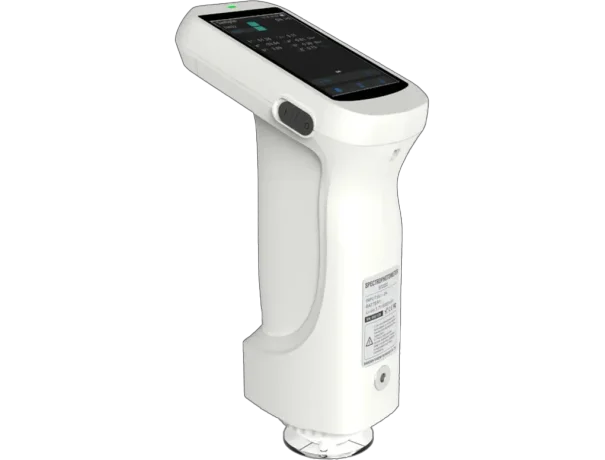
This article explains the fundamental difference in the color measurement principle between a tristimulus colorimeter and a spectrocolorimeter (often called a spectrophotometer in industrial color). You’ll also see how that principle difference affects real decisions: pass or fail, supplier disputes, color matching, and long-term consistency.
You’ll notice the comparison phrase “tristimulus colorimeter vs spectrocolorimeter” in key places. That’s the decision most teams face when they want faster checks, better accuracy, or fewer arguments.
The Core Principle: What Each Instrument Actually Measures
Color is data, not just a look
When you measure color, you’re trying to turn appearance into numbers that stay stable. The challenge is that appearance depends on:
- The light source (daylight, store lighting, LED, warm indoor light)
- The observer (people differ, and standards define “average” vision)
- The surface (glossy, matte, textured, sparkly)
- The material (dyes, pigments, fluorescence, effect additives)
So the instrument has one job: capture the right data so the computed color numbers reflect what you need in the real world.
How a tristimulus colorimeter works
A tristimulus colorimeter is built to imitate human vision in a fast, practical way. Internally, it usually has:
- A controlled light source to illuminate the sample
- A set of optical filters (often three main channels)
- Sensors that read how much light passes each filter channel
- A calculation step that converts the sensor readings into color coordinates
The key idea is simple: it does not measure the full color spectrum. It samples the reflected light through filters that approximate how the eye responds. That is why a tristimulus colorimeter is often quick and convenient for routine checks.
Why “three channels” can be enough
Humans have three main types of cone cells, so many color systems represent a color with three values. In industry, those values often end up as:
- XYZ tristimulus values
- Or Lab* values derived from XYZ
- Or a color difference number like Delta E (ΔE) between a sample and a standard
A tristimulus colorimeter is designed to estimate those values directly using its filtered channels.
Here’s the important limitation: if the filters don’t match the ideal standard curves closely enough, the estimates can drift. Also, because it doesn’t store full spectral information, you can’t “recalculate” the result later under a different illuminant or observer from the same raw measurement.
How a spectrocolorimeter works
A spectrocolorimeter measures the spectrum first. Think of it as taking the reflected light and splitting it into many wavelength bands, then recording how strong the reflection is at each band.
Internally, it typically includes:
- A stable illumination system
- Optics to collect reflected (or transmitted) light
- A dispersing element (or equivalent method) to separate wavelengths
- A detector that reads intensity across the wavelength range
- Software that converts the spectrum into color coordinates under chosen conditions
Instead of guessing color values from three filtered channels, it captures the “fingerprint” of the sample: the spectral reflectance curve (or transmittance curve). Then it calculates color values.
What “spectral reflectance” means
Spectral reflectance is a curve that answers this question:
“At each wavelength, what fraction of light does this sample reflect?”
A red sample usually reflects more in the longer wavelengths and less in the shorter ones. A blue sample does the opposite. A spectrocolorimeter records that pattern across the visible range (and sometimes beyond).
That spectrum is powerful because it can be used to compute color values under different lighting definitions without re-measuring the physical sample.
The one-sentence fundamental difference
A tristimulus colorimeter estimates color using a few filtered sensor channels, while a spectrocolorimeter measures the full spectrum and then calculates color from that spectral data.
That is the fundamental difference in the color measurement principle. Most other differences are consequences of this one.
Why Results Differ: Metamerism, Fluorescence, Geometry, and Surface Effects
If your team is debating tristimulus colorimeter vs spectrocolorimeter, it’s usually because someone has seen “good numbers” that didn’t match real life. The reasons almost always fall into four buckets.
Metamerism: matches that break under new light
Metamerism is the classic trap. Two samples can produce the same color coordinates under one light source, yet look different under another. This happens because:
- The samples can have different spectral shapes
- A specific light source can hide those differences
- A different light source reveals them
A tristimulus colorimeter can miss this risk because it reduces the measurement to three estimated channels. It can tell you “these match right now,” but it can’t fully describe the spectral shape that caused the match.
A spectrocolorimeter helps because it stores the spectral curve. With spectral data, you can:
- Compute color under multiple illuminants
- Compare spectral differences directly
- Identify suspicious matches where the curves differ even if the current color numbers look close
Practical example:
- You approve a plastic part under cool white LED.
- In daylight, the part looks slightly greener than the reference.
- That is often metamerism plus a change in light spectrum.
If metamerism causes customer complaints, the spectro approach is usually the faster path to fewer returns and fewer arguments.
Fluorescence and UV sensitivity
Some materials don’t just reflect light. They absorb energy (often in UV) and re-emit it as visible light. This is fluorescence. Common examples:
- Bright white papers with optical brighteners
- Some textiles and coatings
- Certain plastics and inks
Fluorescence can make a sample look “extra bright” or “bluer white” under lights with UV content. Under lights with less UV, the same sample can look duller or yellower.
This matters in a tristimulus colorimeter vs spectrocolorimeter decision because:
- If the instrument’s illumination and UV handling aren’t controlled and defined, readings can vary more than expected.
- Spectral measurement gives you better diagnostic capability because the spectrum and measurement conditions can be managed more explicitly.
In simple terms: fluorescence is a hidden variable. Spectral tools handle hidden variables better.
Geometry and gloss: the “angle problem”
Even with perfect spectral measurement, geometry matters. Geometry describes how the instrument illuminates the sample and how it collects reflected light. Two common approaches are:
- 45/0 (illumination at 45 degrees, viewing at 0 degrees)
- Diffuse/8 (diffuse illumination, viewing at 8 degrees)
Why it matters:
- Glossy surfaces can reflect light like a mirror.
- Textured surfaces scatter light unevenly.
- Different geometries “see” different mixes of diffuse and specular reflection.
So if you compare measurements from different geometries, you can get different numbers even on the same sample. This is a major source of confusion that gets blamed on tristimulus colorimeter vs spectrocolorimeter, when the real issue is geometry mismatch.
Texture, sparkle, and pearlescent finishes
Effect pigments (metallic, pearlescent, sparkle) can change appearance with angle. These materials can require:
- Multi-angle measurement
- Tight control of sample orientation
- Specialized methods beyond basic tristimulus or single-angle spectral measurement
If you work with effect finishes, you should treat the instrument choice as a system decision:
- Geometry
- Angle control
- Sample handling
- Reporting format
Repeatability vs reproducibility
Two performance words matter:
- Repeatability: the instrument gives consistent readings when the same operator measures the same sample the same way in the same place.
- Reproducibility: different operators, different sites, or different instruments still agree closely enough.
Tristimulus devices can be very repeatable for stable materials and controlled setups. However, reproducibility across sites can be harder if:
- Filter sets differ between models
- Calibration practices vary
- Light sources differ
- Measurement conditions are not aligned
Spectral devices tend to support better reproducibility in multi-site workflows because the raw spectral data is richer and can be processed consistently, assuming the same defined settings are used.
Data and Decisions: What You Can Do with the Output
The choice of tristimulus colorimeter vs spectrocolorimeter is not just “accuracy.” It’s about what decisions you need to make with confidence.
What a tristimulus device typically outputs
A tristimulus colorimeter usually outputs:
- Lab* or XYZ values
- A Delta E (ΔE) difference from a stored standard
- Sometimes pass or fail against a tolerance
This is great for:
- Fast in-line checks
- Sorting batches quickly
- Verifying consistency when the process and materials are stable
Its strength is speed and simplicity. You can train operators quickly. You can measure many parts without slowing the line.
Its tradeoff is diagnostic power:
- If the numbers are off, it’s harder to tell why
- If lighting changes, you can’t easily predict how the match will behave
- If suppliers disagree, you may lack the deeper data needed to resolve it fast
What a spectral device outputs
A spectrocolorimeter outputs:
- Spectral reflectance (a curve or a set of values by wavelength band)
- Computed color coordinates (XYZ, Lab*)
- Computed color differences (ΔE variants)
- Often additional indices relevant to the industry (depending on software)
That spectrum is like an audit trail. It lets you answer questions like:
- Is this a true pigment shift or a lighting shift?
- Do we have metamerism risk?
- Is the supplier using a different colorant system that just happens to match today?
Switching illuminants and observers after measuring
A practical advantage of spectral data is flexibility. If you measure a sample today, you can often compute its color under different standard lighting definitions later without re-measuring the physical sample.
This matters in real workflows:
- A customer approves under one light source.
- Your lab checks under another.
- Spectral data helps you model and align expectations using the same measurement.
Tolerances and color difference formulas
A common mistake is treating any single ΔE as universal truth. In practice:
- Different ΔE formulas behave differently, especially near neutrals and certain hues.
- Tolerances should reflect process capability, product risk, and visual sensitivity.
- You should define measurement conditions clearly, then define tolerances that match real outcomes.
A robust tolerance policy usually includes:
- The illuminant and observer used for reporting
- The geometry used
- The aperture size
- The exact ΔE method used
- Clear pass or fail rules, including what to do with borderline readings
This is where spectro tools often shine. They support deeper alignment across teams, which reduces the “we measured it and got different results” problem.
Choosing the Right Tool: Speed, Risk, Cost, and Workflow
If you want the shortest practical answer to tristimulus colorimeter vs spectrocolorimeter, it’s this:
- Choose a tristimulus colorimeter when speed and routine control are the priority and the material system is stable.
- Choose a spectrocolorimeter when matching, multi-supplier control, risk management, and problem-solving are the priority.
Below is a more operational way to choose.
When a tristimulus colorimeter is the right choice
A tristimulus colorimeter is often the right tool when:
- You’re checking the same product family every day
- Materials and pigments are consistent
- Lighting conditions in evaluation are controlled
- You mainly need fast pass or fail decisions
- The cost of a rare mismatch is low compared to the cost of slowing production
Typical use cases:
- In-process checks on production lines
- Incoming inspection for simple screening
- Quick verification in warehouses
- High-volume sorting where “close enough” is acceptable and defined
In these cases, tristimulus colorimeter vs spectrocolorimeter often comes down to throughput and ease of use. The tristimulus tool usually wins.
When a spectrocolorimeter is non-negotiable
A spectrocolorimeter is usually the right tool when:
- You do color matching, not just color maintenance
- You have multiple suppliers and want consistent reporting
- You approve color standards and must defend the method
- You have frequent disputes about what “matches”
- You work with fluorescent materials, bright whites, or tricky substrates
- You sell products where color is part of the brand promise
Typical use cases:
- Paints, coatings, plastics compounding, and masterbatch control
- Printing and packaging approvals
- Textile dyeing and shade matching
- Automotive interiors and exterior parts
- Cosmetics and high-appearance consumer products
In these workflows, the spectrum is not a luxury. It’s the core asset that makes decisions stable.
A simple decision matrix
| Question | If “Yes” | Recommended |
| Do you need reliable color matching across different light sources? | Metamerism risk is real | Spectrocolorimeter |
| Do you have multiple suppliers or multiple sites? | Reproducibility matters | Spectrocolorimeter |
| Is the product high volume with stable materials and simple pass/fail needs? | Speed matters most | Tristimulus colorimeter |
| Are materials fluorescent or brightened whites are critical? | UV sensitivity is a risk | Spectrocolorimeter |
| Do operators need very fast checks with minimal training? | Simplicity matters | Tristimulus colorimeter |
| Do you need deeper root-cause analysis when color drifts? | Diagnostics matter | Spectrocolorimeter |
Implementation checklist
No matter which instrument you choose, do this to avoid wasted time:
- Define measurement conditions in writing (geometry, illuminant, observer, aperture, backing).
- Create a simple measurement SOP with photos and step-by-step handling rules.
- Set calibration rules (when, how, and who owns it).
- Train operators to measure the same way every time.
- Agree on a tolerance strategy that matches real visual acceptance.
- Run a correlation study if you will compare different devices or sites.
If you skip these steps, you will get inconsistent numbers, and the team will blame tristimulus colorimeter vs spectrocolorimeter instead of fixing the setup.