Force is one of the most fundamental concepts in physics. Simply put, force is a push or a pull applied to an object. When you open a door, lift a box, or press a button, you are applying force.
But force is not just about movement. It is what changes the motion of objects. It can start motion, stop it, or change its direction. Without force, nothing would move.
In physics, force is defined as:
Force = Mass × Acceleration (F = ma)
This simple equation is the foundation of how force is understood and measured.
Why Measuring Force Is Important
You might wonder, why do we need to measure force at all?
The answer is simple. Precision.
In laboratories, engineering, and manufacturing, even a small difference in force can lead to major problems. Imagine a medical device applying too much pressure, or a material failing under load. The consequences can be serious.
Force measurement is critical for:
- Quality control in production lines
- Material testing in laboratories
- Safety checks in engineering systems
- Research and development
Accurate force measurement ensures reliability and performance.
The Standard Unit of Force
The standard unit of force in the International System of Units (SI) is the Newton (N).
It is named after Isaac Newton, the scientist who formulated the laws of motion.
What Is One Newton
One Newton is defined as the force required to accelerate a 1 kilogram mass by 1 meter per second squared.
In formula terms:
1 N = 1 kg × 1 m/s²
To visualize this, holding a small apple in your hand exerts about 1 Newton of force due to gravity.
Other Units of Force
While Newton is the standard, it is not the only unit used to measure force.
Dyne (CGS System)
The dyne is used in the CGS system.
- 1 dyne = 0.00001 Newton
- Mainly used in scientific calculations
Pound-Force (lbf)
Common in the United States and other imperial systems.
Kilogram-Force (kgf)
Based on the force exerted by gravity on one kilogram.
Comparison Between Units
Understanding conversions is essential when working across different systems.
- 1 Newton = 100,000 dynes
- 1 Newton ≈ 0.225 lbf
- 1 Newton ≈ 0.102 kgf
These conversions are often needed in global industries.
Force Measurement Systems
There are three main systems used for force measurement.
SI System
The most widely used system worldwide.
- Unit: Newton
- Based on meters, kilograms, seconds
CGS System
Used in some scientific contexts.
- Unit: Dyne
- Based on centimeters, grams, seconds
Imperial System
Common in the US.
SI System Explained
The SI system is built on base units like:
- Meter (length)
- Kilogram (mass)
- Second (time)
Force is a derived unit calculated from these.
That is why the Newton is expressed as:
kg·m/s²
How Force Is Measured in Practice
So how do we actually measure force in real life?
This is where instruments come in.
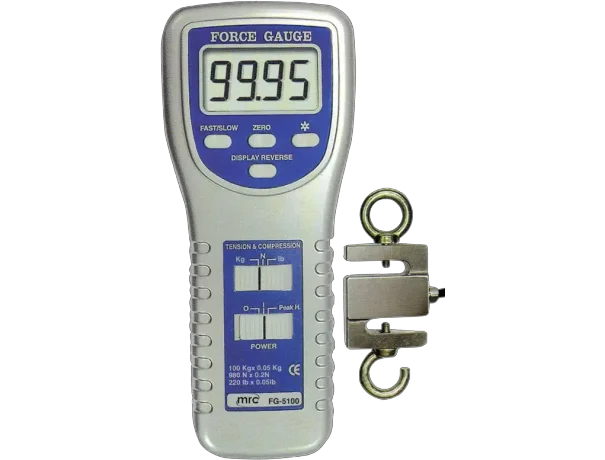
Force Gauges
Force gauges are devices designed to measure push or pull forces.
They are widely used in laboratories, manufacturing, and quality control.
Load Cells
Load cells convert force into an electrical signal. They are commonly used in weighing systems and industrial machines.
Testing Machines
Universal testing machines measure tensile, compression, and bending forces.
Digital vs Mechanical Force Measurement
There are two main types of force measurement tools.
Mechanical Devices
- Use springs or levers
- Simple and durable
- Less precise
Digital Devices
- Use sensors and electronics
- High accuracy
- Easy data recording
Digital force gauges are now the industry standard.
Force Measurement in Laboratories
Laboratories rely heavily on force measurement for:
- Material strength testing
- Product development
- Calibration procedures
For example, testing how much force is needed to break a material helps determine its durability.
Role of Force Gauges
Force meters are essential tools for measuring force accurately.
They are used to measure:
- Tension
- Compression
- Pull force
- Push force
Modern force gauges offer digital displays, data logging, and high precision.
Industrial Applications of Force Measurement
Force measurement is everywhere.
Manufacturing
Ensures product consistency and quality.
Automotive Industry
Tests material strength and safety components.
Aerospace
Critical for structural integrity testing.
Even small force variations can lead to failure, so precision is key.
How to Convert Force Units
Conversions are often required in international work.
Basic Conversions
- N to lbf: multiply by 0.225
- N to kgf: multiply by 0.102
- lbf to N: multiply by 4.448
Example
If a force is 10 N:
- In lbf: 10 × 0.225 = 2.25 lbf
Choosing the Right Unit
Choosing the correct unit depends on the application.
- Use Newton for scientific and international work
- Use lbf in US-based industries
- Use kgf in specific engineering contexts
Consistency is crucial to avoid errors.